Band Pass Filters Make a Huge Difference!
By Jon Adams N7UV
LoRa transceivers are typical all-on-a-chip RF transceivers, just like those SDR sticks, and to a much lesser extent Bluetooth and Wi-Fi. Their front ends are wide, have high dynamic range, and 99% of the signal filtering is done in software. If you've ever used an SDR, you know it sees from "dc to daylight", you can dial it to any frequency its synthesizer/mixing scheme can support and observe signals of interest. Software filtering doesn't protect the receiver front end amp; that sees everything that the antenna and any in-between filtering circuits allow through. LoRa chips are no different - the same Semtech SX1262 that gets used for 433 MHz LoRa is also used for 902-928 MHz Meshtastic or MeshCore, or your local utility meter. The chip itself can support operating frequencies from about 150 to 1000 MHz!
The challenge is that even though you may be interested only in the signals on the LoRa channel, the receiver front end is hearing so much more than you likely imagine. So, here's a small experiment to see what difference if any happens to a LoRa receiver with and without an inexpensive band pass filter.
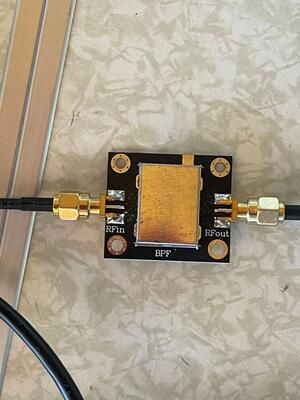
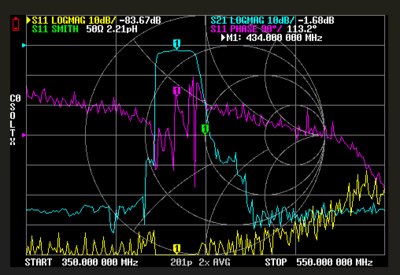
For this test, the transceiver is a QRPLabs LightGateway Plus V1.0. The filter is an inexpensive "433 MHz" filter from AliExpress. You should recognize the filter if you've ever looked on AliExpress. The filter is lumped constant (individual inductors and capacitors). The filter is rated for 100 mW (+20 dBm) maximum. It's not a fancy filter, but it is about 1.7 dB loss (better than advertised) and has a ~3 dB bandpass of 20 MHz. This filter is appropriate for low-power LoRa APRS setups.
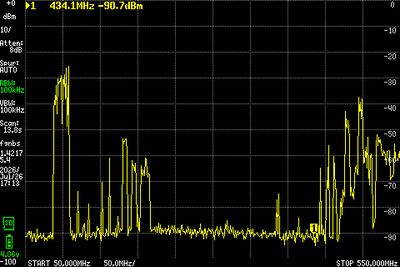
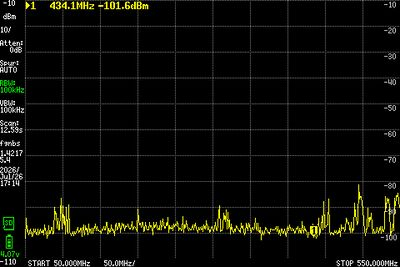
Now let's look at my local RF environment, as measured through the 4 dBi 433 MHz-tuned antenna out on the patio. The screenshot on the left is the 50 - 550 MHz band. On the left side of that image, there's FM broadcast, then a bunch of commercial and public safety systems, then TV transmitters, the "relative" quiet of the 225-400 MHz military/federal use spectrum, the marker that shows our LoRa operating frequency, and higher in frequency are more commercial and public safety systems, and more TV transmitters. The righthand image is the exact same spectrum but with the filter inline. All the stuff that was potentially hitting our LoRa radio's receiver front end has been attenuated by orders of magnitude. Does that matter? YES! But how can we know?
We can't know directly, but we can make some simple observations with the LoRa receiver. The closest LoRa APRS digi to my house is the one at South Mountain (14 mi line of sight, no Fresnel zone interference). Its descriptive call is SOMTNP. There's another digipeater WHTANK (atop the White Tank Mountains, about 25 miles away line-of-sight with no Fresnel zone obstacles. Both should be easily heard at my QTH, even from the mobile.
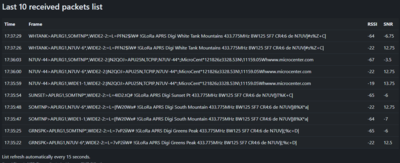
So here's the reception with no filter. SOMTNP is the only station heard direct that's not at my house. The RSSI is about -64 to -67 dBm, the SNR is between -3.5 and -7 dB. For my dead-clear shot, the RSSI is in the ball park. But WHTANK is never heard direct.
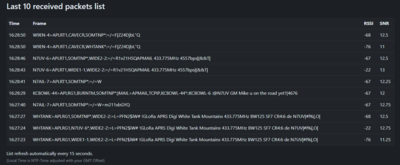
Let's look at the received packets, on that same antenna, with the filter. SOMTNP is reporting RSSI of -67 to -68 dBm (a little worse, as expected) but now with an SNR of +12.25 to +12.5 dB. Note also that WHTANK (digi at ~ 25 mi distance line-of-sight, no Fresnel zone interference) is heard direct, with an RSSI of -76 dBm and an SNR between +11 and +12.25 dB. It wasn't even detected before. Yes, these are only 10 packet samples, but are consistent over thousands of received packets, with only a little diurnal variation.
My situation is probably different from yours - Though I'm on the southwest side of a range of hills, I have an unobstructed 180 deg view including downtown Phoenix, most the metro area's broadcast TV and FM transmitters, dozens of commercial, public-safety, and amateur two-way radio communications sites, and of course all the RF noise generated by half the population of the 5th largest city in the US.
The take-home is that adding that filter to the test setup improved the received SNR by about 18 dB allowing me to hear stations (WHTANK) that were plenty strong, but undetected by the LoRa receiver which was overwhelmed by off-channel noise. The filter insertion loss added 2 dB to my setup. Big deal.
All the digis I deploy have separate band pass filtering. My mobile uses a band pass filter.
Consider using a BPF on your LoRa transceiver. You will likely be very pleasantly surprised.
Cheers and 73 - Jon N7UV